
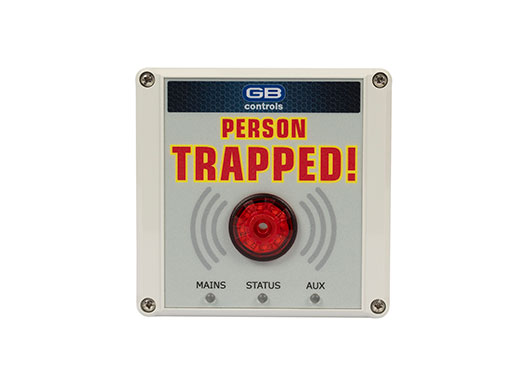
Cold room alarms are meant to protect staff, yet incidents continue to occur. James Hibbert, Director at GB Controls, examines current system standards, common failure points and what engineers say is needed to improve reliability.
Walk into almost any commercial cold room or freezer, and you will usually find a trapped-person alarm button. The principle seems reassuringly simple. Someone becomes trapped inside, presses the emergency button, and an alarm sounds or a beacon illuminates, alerting others that help is needed.
But there is an uncomfortable question that is rarely asked: How do we know the alarm itself is actually capable of working when it is needed?
For equipment whose sole purpose is to protect human life, it is easy to focus on the visible function of the system – the button, the beacon, the sounder – while overlooking something potentially more important: whether the system can detect when its ability to perform that function has been compromised. That distinction matters.
A safety system is only useful if it remains available when someone needs it. A system that appears healthy but has developed a hidden fault can pose a particularly difficult safety problem because everyone may continue to assume that protection is in place.
The hidden risk
Many conventional trapped-person alarm systems are designed with normally open circuits and relatively simple relay arrangements. These designs are inexpensive, familiar and straightforward to install. But simplicity can also introduce a weakness: a fault may occur without producing any obvious indication that the protective function has been lost.
Consider what happens if a conductor breaks, a terminal loosens, corrosion develops, or a relay fails. From the outside, everything may appear normal. The beacon is off. No fault is displayed. No maintenance call is generated.
The system can remain in this condition for months, potentially even years, until somebody presses the emergency button during a genuine emergency. Only then does the failure become apparent.
In functional safety engineering, this type of condition is known as a dangerous undetected failure. A system intended to protect someone who may be isolated in a refrigerated environment deserves serious consideration.
The important point is that the failure itself is not necessarily dramatic. There may be no visible warning, no obvious electrical event and no immediate indication to operators that anything has changed. That is precisely what makes an undetected failure a concern.
Is testing the alarm enough?
There is an important difference between demonstrating that an alarm works during a periodic test and being confident that it remains capable of working between tests.
A routine test can provide useful assurance at the moment it is conducted. But what happens the following day? Or several weeks later? What happens if a component fails between inspections? If the system has no means of identifying that failure, the next test may be the first opportunity to discover it.
That creates a fundamental question for safety-system design: should the person responsible for the facility have to discover a fault by testing the emergency function, or should the system itself be capable of reporting that its protective function has been compromised? Modern safety engineering increasingly takes the latter approach.
Safety systems should monitor themselves
One of the fundamental principles of safety engineering is that safety devices should not merely perform a function; they should continuously verify that they remain capable of doing so. This philosophy is already familiar in machinery safety, burner management systems, process industries and railway signalling.
The underlying idea is straightforward. A safety system should not wait for an emergency to find out whether something has failed. Instead, it should continuously monitor critical circuits, detect internal faults, supervise outputs and provide an immediate warning whenever its protective function may be impaired.
In the context of a trapped-person alarm, that could mean identifying problems such as loss of power, a failed relay, a disconnected alarm device, or an output circuit fault before anyone depends on the system.
The objective is not to make the system unnecessarily complicated. It is to make its condition visible. After all, there is a significant difference between an alarm system that is present and one whose ability to protect people is known.
Eliminating single points of failure
Another important principle of safety engineering is the reduction of single points of failure. Where a single relay, controller or power supply determines whether an alarm will operate, the integrity of the entire protective function can depend upon that one component remaining healthy. If it fails silently, the protection may be lost.
Higher-integrity designs can address this by introducing redundancy, independent monitoring paths and continuous cross-checking between critical functions. The purpose is not simply to improve reliability. It is to reduce the possibility that a single fault can silently disable personnel protection.
This approach has long been established in other safety-critical industries. There is, therefore, a useful question for the refrigeration sector: why should the principles used to protect people in other safety-critical environments be any less relevant when a person is working inside a refrigerated enclosure?
Diagnostics are becoming just as important as alarms
The capabilities of modern electronic systems also change what is possible. A trapped-person alarm no longer has to be viewed simply as a button connected to a beacon or sounder. Electronic systems can continuously supervise their own health and identify developing faults.
Depending on the system architecture, this can include detection of:
■ loss of mains power
■ battery deterioration
■ disconnected alarm devices
■ relay failures
■ processor faults
■ wiring defects
■ output circuit failures
When these conditions are identified promptly, maintenance can be scheduled before personnel safety is compromised.
That represents an important change in philosophy: from reactive maintenance, where a problem is discovered during testing or after a failure, to a more predictive approach, where the system itself provides information about its condition.
For facility operators, this also changes the nature of the question. Instead of simply asking, “Has the alarm been tested?”, it becomes possible to ask, “Has the system continuously demonstrated that it remains healthy?”
Learning from functional safety
The refrigeration industry has traditionally placed considerable emphasis on the mechanical and electrical integrity of refrigeration plant. That remains essential.
However, cold-storage facilities are becoming larger, more automated and increasingly dependent on electronic monitoring and safety systems. As this happens, there is value in looking beyond the refrigeration sector itself and considering established principles from functional safety engineering.
Those principles include:
■ continuous diagnostics
■ independent monitoring
■ fault reporting
■ fail-safe operation
■ redundancy where appropriate
These are established methods of reducing risk by increasing the likelihood that faults are identified before they develop into dangerous situations. The lesson is not that every trapped-person alarm needs to become an unnecessarily complex safety system. Rather, the design should reflect the consequences of failure.
Where an alarm is the final means by which a trapped person can summon assistance, the integrity of that alarm deserves to be considered as carefully as the function it is intended to provide.
Looking beyond compliance
Standards and regulations provide an essential baseline for safety. Compliance is clearly important.
But good engineering can ask a further question. The objective should not be simply to install a trapped-person alarm just because a requirement says one is needed. The objective should be to ensure that the alarm will still function correctly after years of service, component ageing, electrical faults, and unexpected failures.
That distinction may become increasingly important as cold-storage operations become more automated and connected.
Remote diagnostics, condition monitoring, and intelligent fault reporting are already changing the way equipment is maintained. There is an opportunity to apply the same thinking to the systems designed to protect the people working around that equipment.
Ultimately, the question is simple. When somebody walks into a cold room, are we satisfied because there is an emergency alarm on the wall? Or do we want to know that the alarm is continuously checking its own ability to protect them?
For a system whose purpose is to protect human life, that is more than a technical distinction.
The safest alarm is not merely the one that sounds in an emergency. It is the one that has already proved to itself that it still can.
Looking for a reliable trapped-person alarm system?
GB Controls provides personnel safety alarm systems designed to help protect people working in cold rooms and other temperature-controlled environments.
Find out more about our Personnel Safety Alarm or contact GB Controls to discuss your requirements.