
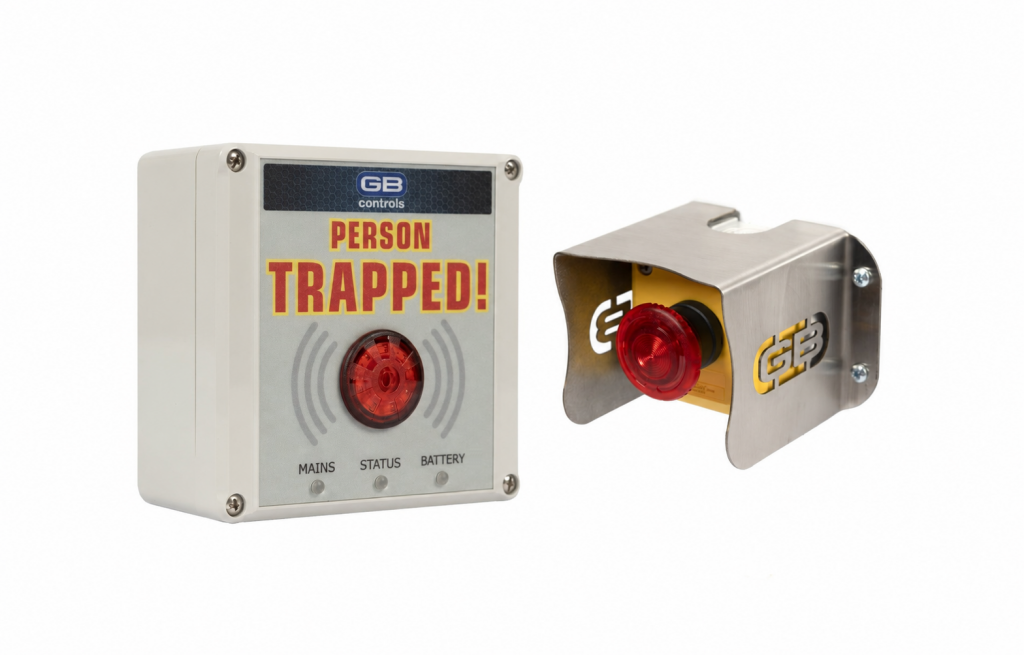
The Challenge with Conventional Trapped Person Alarms
Many conventional trapped person alarm systems rely on a simple arrangement of an emergency pushbutton, sounder, beacon and power supply.
While these systems can provide a basic means of raising an alarm, they often offer little or no supervision of the alarm system itself.
This raises an important question:
What happens if the alarm develops a fault before an emergency occurs?
Power supply failures, disconnected cables, relay faults, battery degradation and electronic failures can all prevent an alarm system from operating correctly. In many cases, these faults remain undetected until routine testing or, worse, during an actual emergency.
For consultants, refrigeration contractors and facility managers, this represents an avoidable risk.
Why GB Controls Developed the Personnel Safety Alarm
The GB Controls Personnel Safety Alarm was developed to provide a higher level of protection for personnel working in refrigerated environments, including walk-in cold rooms and freezers.
Rather than functioning as a simple alarm circuit, the PSA uses high-integrity, fail-safe architecture designed to continuously verify the health of critical system components.
This approach helps ensure that the system remains capable of responding when a trapped person requires assistance.
The result is a more robust solution for applications where safety, reliability and duty of care are paramount.
High-Integrity Monitoring as Standard
The GB Controls Personnel Safety Alarm continuously monitors multiple aspects of system operation, including:
- Mains power availability
- Battery backup condition
- Alarm relay functionality
- External beacon and sounder connections
- Internal processing functions
- System cross-check integrity
Should a fault occur, the system provides clear fault indication, enabling maintenance teams to identify and rectify issues before safety is compromised.
This level of supervision is not normally found in conventional cold room trapped person alarm systems.
Fail-Safe Protection During Power Loss
A trapped person alarm is only effective if it continues to operate when mains power is unavailable.
For this reason, the GB Controls PSA incorporates battery backup capability, allowing the system to remain operational for up to 10 hours during mains power failures.
Unlike many basic alarm systems, the PSA also monitors the condition of its backup power source, helping facilities maintain confidence in the system’s ability to perform during an emergency.
This feature supports the recommendations contained within BS EN 378-1:2016 Annex D and helps ensure personnel remain protected during power outages.
Supporting Safer Cold Room and Freezer Environments
Walk-in cold rooms and freezers are often located in isolated areas where personnel may be working alone or out of sight of colleagues.
In these situations, rapid assistance can be critical.
A properly designed Personnel Safety Alarm provides an additional layer of protection by enabling trapped occupants to immediately raise an alarm, while ensuring the alarm system itself remains continuously monitored.
This is particularly important in:
- Cold storage warehouses
- Food manufacturing facilities
- Pharmaceutical storage areas
- Distribution centres
- Commercial refrigeration installations
- Industrial freezer applications
A Better Approach to Trapped Person Protection
At GB Controls, we believe a trapped person alarm should do more than activate a beacon when a button is pressed.
It should actively verify its own operation, identify faults before they become safety issues, and continue functioning when conditions are less than ideal.
That philosophy is why we developed our Personnel Safety Alarm using high-integrity fail-safe technology, rather than the simple alarm architectures commonly found elsewhere in the market.
Looking Beyond the Specification
When specifying a trapped person alarm for a cold room or freezer, consultants and facility managers should consider more than basic functionality.
Questions worth asking include:
- Does the system monitor itself for faults?
- Will it continue operating during a power failure?
- Can maintenance teams easily identify system issues?
- Is the alarm output monitored?
- Does the design follow fail-safe principles?
The answers to these questions often determine whether a system simply complies with a requirement or genuinely enhances personnel safety.
Personnel Safety Alarms from GB Controls
The GB Controls Personnel Safety Alarm has been developed specifically to provide high-integrity trapped person protection for walk-in cold rooms and freezers.
By combining fail-safe design, continuous self-monitoring, battery-backed operation and comprehensive fault detection, it offers consultants, contractors and facility managers a more dependable approach to protecting personnel working in refrigerated environments.
Designed to detect faults, withstand harsh environments and continue operating when needed most, the PSA delivers a level of protection that goes far beyond a conventional trapped person alarm system.
Contact GB Controls today to learn more about implementing a Personnel Safety Alarm system within your cold storage facility.